Blog
How to Buy Research Peptides Safely: The 10-Point Quality Checklist
Purity claims are easy to print and hard to prove. This guide shows you how to read a certificate of analysis, what HPLC and mass spec really tell you, and which red flags should stop an order.
Key takeaways
- Insist on a batch-specific COA whose lot number matches your vial.
- You need two tests: HPLC tells you how pure the sample is; mass spectrometry tells you what it is.
- Look for 98% purity or higher, a named independent lab and net peptide content on the report.
- The biggest red flags are no COA, prices far below market and sellers giving human dosing advice.
- Know the law. Research peptides are not approved medicines, and in 2026 the FDA warned sellers that "research use only" labels don't protect them if they market to humans.
01Why peptide quality varies so much
Two vials with the same name can contain very different things. Peptides are built one amino acid at a time, and every step can go slightly wrong. The result can include:
- Deletion or truncated sequences: chains missing one or more amino acids that look almost identical to the real peptide.
- Leftover synthesis chemicals, such as TFA counter-ions, which can affect cell assays.
- Under-filling: less peptide in the vial than the label says.
- Degradation in transit from heat or moisture if the vial was poorly sealed or stored.
- Mislabelling: the wrong compound entirely.
In research, any of these quietly ruins your data. The only defence is documentation you can verify, which is what the checklist below is built on.
02The 10-point supplier checklist
Open the supplier you are considering in another tab and tick each point you can actually confirm. Your score updates as you go.
03How to read a certificate of analysis (COA)
A COA is the lab report for one specific production batch. Here is what a good one contains. The example below is an illustration of the layout, not a real report.
- Product and sequence. The full amino-acid sequence lets you calculate the expected molecular weight yourself.
- Lot number and date. This must match your vial. A COA without a lot number tells you nothing about your sample.
- Appearance. Most lyophilised peptides are white or off-white. Yellowing or clumping can point to moisture or degradation.
- HPLC purity. The percentage of the sample that is the target peptide. 98%+ is a good research standard; 95% may be fine for screening work.
- MS identity. Proves the molecule has the right mass. Without it, a "99% pure" sample could be 99% of the wrong peptide.
- Net peptide content. Use this to correct your concentration maths. Our reconstitution calculator explains how.
- Water and counter-ion. Explains the gap between gross weight and actual peptide.
- Who tested it. A named, contactable lab and a report ID you can verify are worth far more than a logo on a PDF.
04HPLC vs mass spectrometry: why you need both
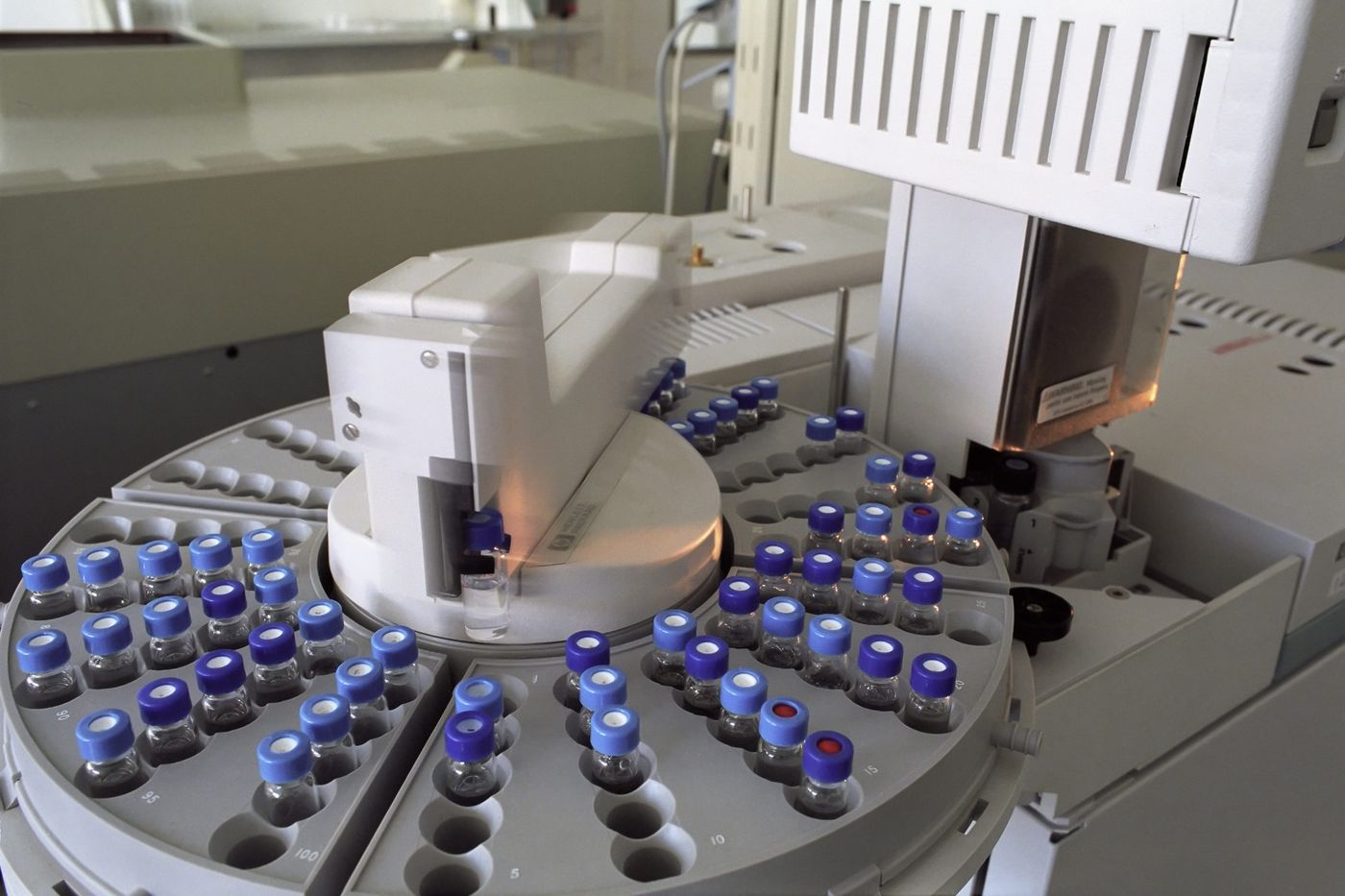
HPLC: how pure is it?
- Separates the sample into its components.
- Purity % = the main peak's area ÷ all peaks combined.
- Shows impurities such as deletion sequences.
- Cannot confirm identity. A wrong peptide can still show one clean peak.
Mass spec: is it the right molecule?
- Measures molecular mass very precisely.
- Observed mass should match the theoretical mass of the sequence.
- Confirms you received the compound you ordered.
- Does not measure purity on its own.
Together, the two tests answer the only two questions that matter: is it the right peptide, and how much of the sample is that peptide?
05Red flags that should stop an order
No COA, or the same COA for every batch
If the lot number never changes, the report isn't about your vial.
"100% pure" claims
Real analytical methods report figures like 98.7%, not perfection.
Prices far below market
Peptide synthesis and testing cost money. Prices that look too cheap usually mean the testing was skipped.
Human dosing advice
Injection guides, "cycles" or before-and-after photos for unapproved compounds signal a seller ignoring the rules.
No company details
No address, no policies, no one to answer a technical question about a batch.
Poor packaging
Vials with no lot or expiry, loose caps, or powder that looks wet, yellow or melted.
06The 2026 legal landscape in brief
Rules on research peptides are changing quickly. Here is the current picture, based on public reporting:
- Research peptides are not approved medicines. Compounds such as retatrutide are still investigational. Approved drugs like semaglutide and tirzepatide are only legally supplied as medicines through regulated channels.
- September 2026: the FDA sent warning letters to five online peptide sellers, naming products such as retatrutide, semaglutide and tesamorelin. The agency rejected the sellers' "not for human use" disclaimers because their websites showed the products were intended for people.
- February 2026: HHS announced that about 14 of 19 peptides on the FDA's restricted "Category 2" compounding list (including BPC-157, GHK-Cu, Semax and others) would move back to Category 1. That affects licensed compounding pharmacies only. It is not FDA approval and does not establish safety or dosing.
- Outside the US, import and possession rules vary widely by country. Check your local regulations before ordering.
Buy research peptides for legitimate laboratory research only, from suppliers who market them that way. That protects your research, and it protects you.
07Our quality standard at Lian Peptides
We wrote this checklist because we want customers to hold us to it. Here is what you can expect from every order:
- Lot-numbered vials with compound, amount and lot printed on the label.
- Certificates of analysis with HPLC purity and mass-spec identity. If one isn't on the product page, ask us and we'll send the COA for your batch.
- Lyophilised, crimp-sealed glass vials packed to protect stability in transit.
- Research-only marketing. We publish education, not dosing advice.
- A real team you can contact with technical questions before and after you order.
Retatrutide
5 · 10 · 15 · 20 · 30 mgTriple GIP/GLP-1/glucagon agonist.
View productTirzepatide
5 · 10 mgDual GIP/GLP-1 agonist.
View productFull catalogue
Browse allMetabolic, growth-factor and cosmetic research peptides.
View productRun the checklist on us
Browse the catalogue, check the specifications, and ask our team for the COA on any batch before you buy.
FAQFrequently asked questions
What purity should research peptides have?
For most laboratory research, look for HPLC purity of 98% or higher. Screening work may accept around 95%; sensitive quantitative or cell-based assays benefit from 99%+.
How can I tell if a peptide COA is real?
Check that the lot number matches your vial, the test date is recent, a named laboratory is listed with a report ID, and both HPLC and mass-spec results are included. If in doubt, contact the testing lab and quote the report ID.
Is HPLC testing enough on its own?
No. HPLC measures purity but cannot confirm identity. Mass spectrometry confirms the molecule has the correct mass. A trustworthy COA includes both.
What is net peptide content?
The share of the powder that is actually peptide, typically 70–90%. The rest is counter-ions (such as acetate or TFA) and water. Use it to correct concentration calculations for precise work.
Are research peptides legal to buy?
It depends on the compound and your country. Research peptides are not approved medicines. In the US, the FDA has issued warning letters to sellers that marketed unapproved peptides for human use despite "research only" labels. Check your local regulations and buy only for legitimate laboratory research.
Why does my peptide vial look almost empty?
Lyophilised peptides form a small cake or thin film, and a few milligrams take up very little space. It is normal. Tap the vial before opening so any powder settles to the bottom.
REFSources
- Pharmaceutical Technology. FDA cracks down on black-market peptide trade (warning letters to five online sellers), Sep 2, 2026. pharmaceutical-technology.com
- Pharmacy Times. The peptide reclassification everyone is talking about: a pharmacist's take, Jun 4, 2026. pharmacytimes.com
- Sigma-Aldrich (Merck). Handling and storage guidelines for peptides. sigmaaldrich.com
- Sigma-Aldrich (Merck). Peptide solubility guidelines. sigmaaldrich.com
Keep reading
We write plain-English guides to the peptide research literature and lab handling, and we cite primary sources so you can check every claim yourself.